Showing posts with label Debra Dixon. Show all posts

Monday, 22 July 2019

Okay, Just One More


I’m going to own up to this right now. I have a problem—it’s a good problem—but a problem none-the-less.

I am addicted to writing craft books.

I just can’t say no! They are like my own form of Pringles! Maybe not so tasty but certainly better for my hips. 
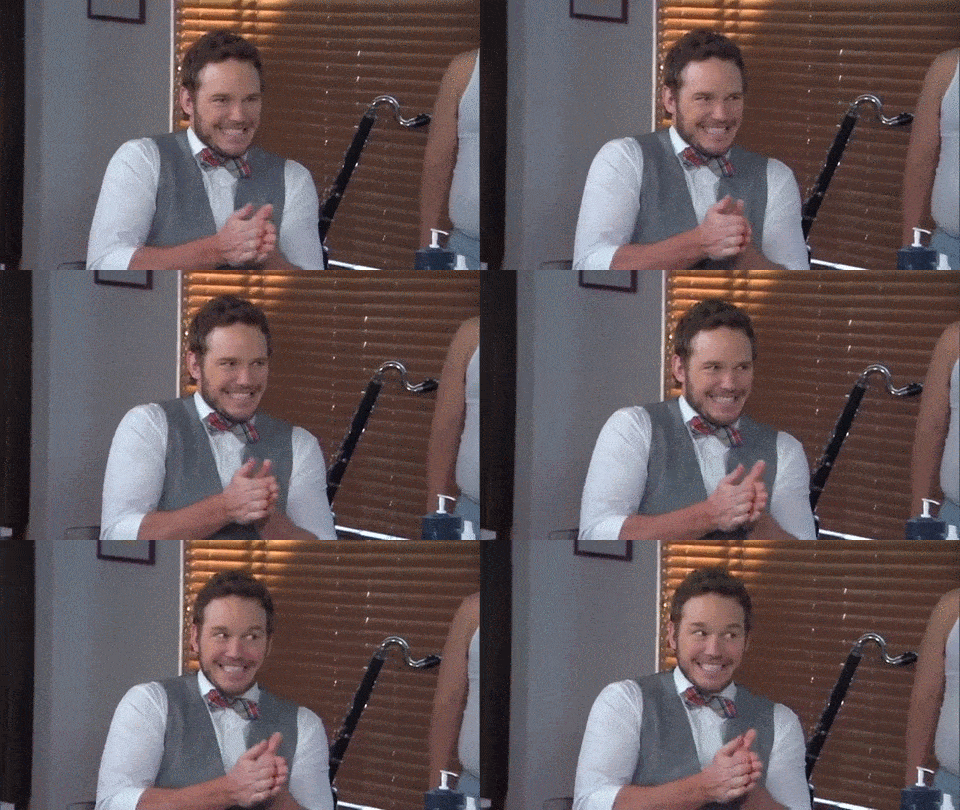
Image courtesy of giphy.com


This has been a lifelong habit for me; Whenever I find a topic of interest I always go overboard. E.g. Husband bought me a rose, but how does one look after a rose? Off to the library I went, seventeen books on roses later, well let’s just say I haven’t killed the rose yet.

With writing craft books, I started small. I went to the library and borrowed/reserved every writing book I could get my greedy little hands on. There weren’t a lot that actually covered my genre: Romance. That meant it was time to dig deeper. Booktopia, Ever After Book Store, Amazon… One little click into Google and I was buried with suggestions on the best ever romance writing craft books.

My writing craft collection

Over time I’ve built up quite a little collection (see picture above) But I thought I’d do a mini run down on those that I CANNOT live without. These babies sit beside me as I write, their corners well licked from my desperate thumbing of pages to find the information I need.

GMC – Debra Dixon
I think this is like a unicorn craft book – all bright, sparkly and beautiful. It’s mythical in its printed form but I was lucky enough to score a hardback from my local romance store and boy do I love this book. The authors tone is enjoyable and her information so darn easy to understand.


The Emotion Thesaurus – Angela Ackerman & Becca Puglisi

I’m going to add here that ALL the thesauri are incredibly insightful and useful for writers of any genre. Also the websites; https://writershelpingwriters.net & https://onestopforwriters.com are brilliant and I’ve often found myself losing hours just reading all the craft blogs and traipsing through the wonderful information contained on both of these sites. The emotion thesaurus though has REALLY added depth to my characters. It has improved my showing through visceral reactions, and I find myself now studying other people, matching their reactions to those outlined under the emotions in the books (yes I probably look weird; but I also hear voices in my head so really what hope is there!)


Romancing the Beat – Gwen Hayes
This is short, sweet and simple. I love the breakdown of beats for a romance novel. I mainly write category length, so I found this breakdown particularly useful for that. She also has some great follow up information on her website including a free scrivener template that has the beats laid out so you can just open and get writing. Her sense of humour had me chuckling whilst I soaked up her information like a sponge. I also found myself creating a playlist from her suggestions – though I will admit I can’t listen to it whilst I write.


These are my top three and they have all helped add structure and depth to my stories J Particularly GMC – the first few manuscripts I wrote I have now revisited – realising there was an underlying story but not enough strong conflict to sustain reader interest. My characters were flat and boring without obvious goals and motivations. Now I have a better understanding of GMC I really feel my stories have improved dramatically. It’s been a lifesaver!

If anyone is keen on some further reading on GMC, please let me recommend these excellent Blogs:


I love to love... romance craft books
I love to laugh... at my terribly messy desk
I love to learn... what other’s turning points were for their writing

How about you? Do you have any favourite writing craft books you simply cannot live without?

Monday, 1 April 2019

Character Motivation

By Alyssa J. Montgomery

Debra Dixon's much cited writing bible, 'Goal, Motivation & Conflict' explains that the motivation is what compels the character to achieve his or her goal. (If you're a writer and don't have this book, I can tell you it's one of the most helpful how-to books I own.) On motivation, Dixon writes "Keep it simple. Keep it strong. Keep it focused." Motivation is also referred to as the Why of the story and can be a key element in helping the character be three dimensional and also have the reader empathise with him or her. For a reader to become engrossed in the plot, the motivation must be clear and should be compelling.

There are many different goals a character can have, and even those who share the same goal may have different motivations for doing so. If you're looking for different character motivations, check out the sites:

https://writershelpingwriters.net/character-motivation-

thesaurus/https://tvtropes.org/pmwiki/pmwiki.php/Main/MotivationIndex

Newton said that an object will tend to remain at rest unless it's acted upon by an outside force. Perhaps it's an internal motivator or perhaps it's an external force, but there has to be something that motivates a character into action and to direct the choices that character makes.

Coming from a large and very loving family, I know that through my close bond with my parents and siblings, any one of us would be prepared to go to whatever extraordinary lengths possible to in order to help each other. I've used family motivations in a number of my books. In my medieval 'Knight of Her Heart' (published as Alyssa James) I have a heroine who's trying to save her sister's life and in 'Knight of Her Desire', a mother who's trying to protect her child. My hero in the former is motivated by revenge and in the latter, the hero is motivated by a sense of duty and conscience.

I tend to like motivations which involve family because I find them compelling and easy to relate to. Whether the character is motivated to do something to help a relative survive, get out of debt, achieve a career goal - I'm happier to read these types of motivating factors than a motivation centered around attaining a career goal or wealth or something material. That's not to say those stories aren't appealing to me - just that the family motivations appeal more.

 
In my latest contemporary release, 'Seduced by the Enemy' the heroine is motivated to become a part of her niece's life and to try to save her life. In each of these stories, the motivation was urgent and ensured the characters would meet the roadblocks and challenges I set for them to make it difficult for them to achieve their goals.

Obtaining Justice is my hero's motivation in 'The Irredeemable Prince' and it's such a strong motivation he doesn't mind attracting the scorn of a nation to do it.

Honouring a sense of duty and feeling a sense of guilt are motivating factors for both the hero and heroine in my novel, 'The Defiant Princess'. Their motivation drives them to their goal, despite their beliefs that this goal stands in the way of their own personal happiness. Now, while in this story the characters have the same goal and motivation, the conflict arises because they both want to achieve the goal in a different way.

Whatever the character's motivation is, it needs to be set in a way that the reader can relate to it - feeling the same sense of urgency and investment, struggling with the choices that need to be made but understanding and relating to those decisions.

How do I decide what my characters' motivations are? Like most authors I do an author interview that helps me to know each character's backstory. Who are they? What makes them tick? What's happened to them to make them the way they are? What do they most want? Why do they want it?
What's stopping them from getting it? How are they going to overcome the roadblock?

I'd love to hear from you.
Of the romances you enjoy reading, do you have a favourite motivational theme?
Have you ever read a romance where you have come across a really unusual motivation for the character - or one you simply can't relate to? 
If you're an author, do you gravitate more frequently to one type of character motivation than another?

Love to Love: Characters motivated to help others whether it's their friends or families.
Love to Laugh: At comical situations created by authors as the characters try to attain their goals.
Love to Learn: About what makes characters tick. Why do they want what they want?


Monday, 7 March 2016

Miranda's March Musings: Romance Reference Books To Love!

Darlings, did you catch Dee's post last week about setting goals in your writing? Thanks Dee, great stuff. So, where to start with your writing?


Photo credit: www.amazon.com

This month I'm going to show you some terrific writing reference books that have helped us at Breathless in the Bush - or that I simply loved to read. Though I'm a reader first, I love and adore reading books about writing. The two go hand in hand, don't they? One of them might just provide the spark to kickstart your writing. So go, you...!


One of the first books I read was the beautiful (but sadly out of print) To Writers With Love by Mary Wibberley, who wrote a lot of gentle Mills & Boon in the 1970s and 80s. Like Dee's post last week, this is an inspirational book to get you going and to think and plan, but mostly to enjoy your romance writing. If you can find it in a used version I'm sure you'll love it.


What about more modern (and available!) How-To's? The fabulous Valerie Parv AM has written a superb book everyone needs to read: The Art Of Romance Writing. Go to the top of the queue to attend a course by her or to hear her speak (thank me later). Valerie, for all the love you've given romance writers - and readers - all over the world, we salute you.

Photo Credit: http://www.valerieparv.com/artof.html


Bear with me... I want to let people know about three more incredibly helpful books. The first is a special favourite, The Writer's Journey by Christopher Vogler. Even if you're not a writer you'll be fascinated by the way Vogler works out structure and analyses mythology's influence on books and movies. It mesmerised me the first time I read it, and it hasn't lost any of that allure. Makes writing seem almost easy. ...Almost!

Picture Credit: www.thewritersjourney.com

I really enjoyed The Complete Writer's Guide to Heroes and Heroines by Tami Cowden. If you're struggling with your hero or heroine, and can't work out 'who' you want them to be, this book is your answer. Terrific in-depth stuff that will have your pen itching to hit the page. Or your fingers dance along the keyboard...

Picture Credit: www.amazon.com

I could go on and on - honestly, once you start about writing books, the list is absolutely endless - but the last one I want to mention is the amazing GMC by Debra Dixon. Every scene in your book should have a goal, a motivation, and a conflict. Sound too hard? Not the way Debra describes it. Read it and your writing will take on a new verve and interest.

Picture Credit: www.amazon.com

...And I haven't even mentioned The Emotion Thesaurus by Angela Ackerman & Becca Puglisi, or Save the Cat by Blake Snyder, or Vanessa Grant's Writing Romance, or reference books such as What Jane Austen Ate and Charles Dickens Knew by Daniel Pool, or.. or....

Every writer I know has their absolute favourite How-To's. What are yours? Do share with us: let us know what motivational or reference book has helped your writing journey - and it just might help someone else as well.

STOP PRESS! Valerie Parv is giving away a copy of her book The Art Of Romance Writing to one lucky commenter. So post those comments now!

Till next time my lovelies,

Miranda xx


I love to love: Jane Austen! Just re-read Northanger Abbey and loved it all over again.

I love to laugh: at funny cat videos on the internet. Yes, I'm a tragic...


I love to learn: what people are reading. Seriously. Please share.