Showing posts with label plotter. Show all posts

Monday, 11 July 2022

Plotter or pantser?

Ways of writing 

By Sharon Bryant

How do you approach your writing? Are you a plotter who creates a detailed outline before you begin your novel? You may be a pantser who prefers the more organic approach of not knowing where a story is going when you begin to write it. Perhaps your approach to writing lies somewhere between these two extremes. 
Plotters often consciously utilise the structure of a romance novel when they are in the planning stage. They may make detailed notes re their characters, settings and plot lines. Some will use cards to summarise the key events in each chapter as they plot out the hills and valleys of their stories. Many story problems can be identified in the planning stage using this approach. Plotters may also know their characters well before they start to write. This can result in producing well-rounded characters who the reader can relate to. 
Pantsers may dislike detailed plotting, finding it stifles their creativity. Instead they allow their story to develop organically. If they reach a dead end, they go back, identify the problem and rewrite as needed.
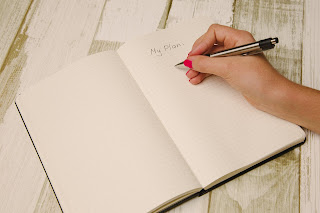
pixabay.com.au

Which approach is the best? 

I don't believe one approach is better than the other. Both have advantages and disadvantages. 
Plotters know their destination. This may make it more likely for beginning writers to finish a novel without getting lost on the way. If you prefer not to write your novel from start to finish, plotting may help you link different scenes together. It may also allow you to avoid extensive rewriting. 

Of course, the plotting approach has disadvantages. You need to put in a lot of work before you begin writing your novel. Plotters may spend so long in the plotting stage, that they find it difficult to begin writing. Some plotters lose confidence and leave a project without starting their actual novel.

pixabay.com.au

Pantsers have the freedom to just begin writing, and take their story wherever they wish. They spend more of their valuable writing time, immersed in the writing process so it may be easier for them to develop their own voice. This immersion may aid the creation of well-developed characters. 

On the other hand, pantsers may write themselves into a corner, and become blocked, uncertain where the story should go next. Some writers find this very frustrating. They may also find it more difficult to write when inspiration doesn't strike. 


pixabay.com.au

 How do you approach your writing? 

There is no one correct way to go about writing your novel or short story. Your approach will be as individual as you are. How do you write? Are you a plotter, a pantser or somewhere between? 

I love to love thinking about what I may write. 
I love to laugh with my writing friends. 
I love to learn more about the process of writing.

Monday, 30 July 2018

When Characters Have a Mind of Their Own

by Enisa Haines

I had believed myself a plotter when I wrote my first manuscript. I planned out the plot - 'What if this?' and 'What if that?' - in comprehensive detail. I knew the characters and what would happen and when and where. I worked on the outline, the events of each chapter, the synopsis. I wrote the book and I wrote it fast, but when I reached 'The End' something about the process didn't feel right. 

Image courtesy of: CCO Creative Commons

I spent many an hour wondering why. Too rigid and methodical, I realised, for a writer like me, happiest when my creativity is spontaneous. And in that happy state, my imagination let loose a vision. I saw this guy on a motor bike travelling down a winding road and I got to thinking: Who is he? Why is he on the road? Where is he going? The answers and the visions that then appeared gave me my second manuscript, and another revelation.

I'm not a plotter or a pantser, 'flying by the seat of my pants' planning only the basics or nothing at all. I'm not a plantser, plotting some of the story. I am a scener. I imagine scenes. They come in no particular order so there's some juggling done for them to make sense but they and the characters they reveal are the story.


Image courtesy of: archanN on  Wikimedia Commons 

That's not all. One day I was thinking of a character and he spoke to me. Yes, I had visualised him, a product of my imagination,  but he wanted things done his way. At first I ignored his urging - characters don't speak to their writers - and wrote the scenes as I had imagined them. But he was persistent, rejecting what I'd written so I gave in and wrote what he wanted me to write and introduced another character I had not envisaged. A character I knew immediately was pivotal to the plot and the happy-ever-after ending my hero character deserved.


I soon understood that characters, though coming into existence from my subconscious, are real in my mind. They take on a life of their own with their own thoughts and feelings and react in their own ways to situations they find themselves in. Maybe it's weird but I believe their stories are not my stories. I just write them and that, in itself, is magic.

Do your characters speak to you, ordering you to write as they want? Do you let them shape the story or do you rein them in?

Love to love: reading, immersing myself in the tales of characters imagined and yet feeling so real.

Love to laugh: at the often-strange-and-funny quirks fictional characters have.

Love to learn: about the many differences that make the characters who they are.

Monday, 7 September 2015

Are You a Plotter or a 'Fly by the Seat of Your Pants' Writer?

with Karen M. Davis

Probably stating the obvious here but, to be clear, the definition of "flying by the seat of your pants" is deciding a course of action as you go along, using your own initiative and perceptions rather than a pre-determined plan or mechanical aids. Being a "plotter" is devising the sequence of events in (a play, novel, movie, or similar work).

While visiting rural towns and talking to book lovers around NSW on the Australian Voices in Print tour with fellow authors Jenn J McLeod and Tricia Stinger earlier this year, we were asked numerous questions. Of course that was why we were there - to share our stories and love of reading and writing - and I would say the most common question was about our writing process. Do you write so many words a day? Do you set a routine? Do you plot or fly by the seat of our pants? Interestingly, our three individual answers were different.

 http://tse1.mm.bing.net/th?&id=OIP.Mfaf9004e1f306f57327737cd9286312eH0&w=300&h=300&c=0&pid=1.9&rs=0&p=0&r=0
Jenn explained that she starts with a title, a leading character's name, an idea and then writes by the seat of her pants, goes where the words take her. She calls herself a pantser. Tricia has a vague idea of what the story is about but often doesn't know what will happen until she writes it. She sometimes changes her characters' names when she gets a feel for their personalities and admits to taking pleasure in picking unpleasant names - in her opinion - for unpleasant characters.

http://tse1.mm.bing.net/th?&id=OIP.M0e2cbfe38b5f9bd0d683c782aa983860o0&w=300&h=300&c=0&pid=1.9&rs=0&p=0&r=0
I consider myself a combination of a plotter and a pantser. I need a rough outline of what's going to happen because in writing Crime Fiction there is always a crime that needs solving. There are hints to be dropped, investigation details to explain, leads and breakthroughs to demonstrate, and then all loose ends have to be tied up, so some plotting is necessary. However, I don't start with a title, I begin with an idea - usually one I pull from my personal catalogue of experiences, and I build on it from there. I decide early on who my POV characters will be so the story can be told from different perspectives. I start off with a definite on who my bad guy/girl is and that usually changes along the way. While writing my second book, Deadly Obsession, I began to like the bad guy so I switched that role to a character I didn't like. So as much as I do like to plot, I like the story to develop on its own also. Scenes constantly change as the story progresses and often, when I read over what I have written, I wonder where it came from. I'm guessing most writers can relate...

So what are you: a plotter, a pantser, or a bit of both?

I love to love to relax with a good book (when I can)

http://tse1.mm.bing.net/th?&id=OIP.M88cda60da4782c8a2e2c967167466f07o0&w=300&h=300&c=0&pid=1.9&rs=0&p=0&r=0
I love to laugh at funny cat video's

http://tse1.mm.bing.net/th?&id=OIP.M233a3e3312747ae8e6c85f297620353do0&w=300&h=300&c=0&pid=1.9&rs=0&p=0&r=0
I love to learn about animals doing interesting things

 http://tse1.mm.bing.net/th?&id=OIP.Ma6db75a912f311eba5357deba0ba84dcH0&w=300&h=300&c=0&pid=1.9&rs=0&p=0