Showing posts with label Easter. Show all posts

Monday, 10 April 2023

The myth and folklore that is the Easter bunny and his eggs

 By Cassandra Samuels

It is Easter Monday, so I wanted to talk about that other part of Easter.

Everyone loves Easter, if not for the religious aspect, then for the love of chocolate. How did a rabbit become tangled in all this? And how is it connected to eggs? That is what I am going to try and explain today. \
Courtesy of Creative Commons
 We all know they don’t lay eggs so how are chocolate eggs connected? To explain we must go all the way back to the Pagans. They celebrated the festival of Eostre or Ostara (a great northern goddess of Spring) whose symbol is the hare. 

courtesy of Creative Commons
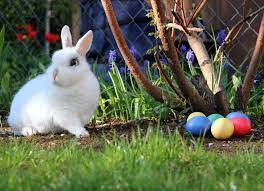
Easter, as you know is not a fixed date every year, but is commanded by the phases of the moon, again a nod to the pagans. The hare also represents spring and fertility. We all know the saying about rabbits, so what about the eggs because we all know rabbits do not lay them. 


Photo by Bermix Studio on Unsplash

Since ancient times German folklore has connected rabbits and eggs where the Easter Rabbit puts colourful eggsin nests and baskets of good little children. They then took this custom with them as they migrated around the world.  

The Greeks have a more orthodox reason for dying eggs red at Easter. The egg is dyed red to represent Christ’s blood, its shell the tomb of Jesus and the cracking of the shell the resurrection from the dead and escaping his tomb. 

Photo by ALEXANDRA TORRO on Unsplash


But what about the chocolate? I hear you ask. In the early 19th century France and Germany started introducing chocolate eggs as eating chocolate. Before that chocolate was consumed as a drink but once they perfected the process of separating Cocoa from the seed, they were able to start using chocolate as it is mostly consumed today. Apparently, Fry and sons around 1860 invented the first chocolate bar from paste, sugar, cocoa butter, and chocolate liquor and moulded into a bar. Fry’s first chocolate easter egg was around 1873. 

Courtesy of Preston's Museum

The first Cadbury Easter egg was made in 1875 and now there are more types of Easter chocolate than you could possibly consume. 

So, there you have it. Easter is a combination of folklore, festivals, and religion. Over time they have become combined in a celebration that can be shared by all.  

I hope your Easter break was a wonderful one. How is your Easter spent? Have you ever read a Romance novel set over Easter? 

Love to love watching the children participating in the Easter egg hunt. 

Love to learn all about how the first chocolate eggs were made and how they related to the Easter Bunny. 

Love to laugh at my silly new puppy Buddy as he plays with his toys.

Monday, 6 April 2015

Easter Egg Traditions in Russia


with guest blogger, Suzi Love

Easter was introduced at the end of the 10th Century in Russia and became a time of family
celebrations. Starting as long ago as the Pagan times there was a tradition to paint eggs red, symbolising the sun that ancient people worshipped and to celebrate the awakening of nature after winter. Russians gathered with their family and close friends and such a celebration lasted seven days, the whole Bright Week. Elegant coloured eggs were part of the ritual, but also gifts.


On Easter Sunday, there was a custom of kissing. When people visited at Easter, they took with them painted eggs and greeted each other by saying 'Christ is risen'; the other person replied 'He is risen indeed'. They then kissed each other three times and presented Easter eggs.


In the 18th and 19th centuries at the courts of the Russian Emperors, tsars presented eggs to their retinue. Some were painted with biblical scenes, views of St Petersburg and Moscow, or coats of arms, while special gift souvenir eggs were made of wood, papier-mâché, porcelain, glass, stone and precious metal. If coloured stone was used they were carved and polished, after which they took on a golden or silver-pearl brilliance and appeared to emit light.


Easter eggs were symbolically painted in the colour of the Saviour's blood, which became even more significant at the war fronts where soldiers fought and died and blood was shed. The feast of the Resurrection became associated with the hope of salvation and the redemption of sins through personal courage and self-sacrifice.

Tsar Nicholas's family spent their last Easters at the front and in military hospitals, exchanging the traditional triple kiss with soldiers and giving them gifts. Soldiers were given red eggs with the St George Cross, known as "the soldier's cross" because it was awarded to the lower ranks i.e. privates, seamen and non-commissioned officers. Dowager Empress Maria Fiodorovna commissioned her own personal series of eggs with a red cross and rich decoration and in 1916, 2,000 of these eggs were made and she gifted a thousand of them to wounded soldiers.


Nicholas II's diaries make it possible to recreate episodes from the Easter celebrations at the court of the last Russian emperor. In the entries for 1894 we find Grand Duke Nikolai Alexandrovich celebrating one of his happiest Easter weeks, when the heir to the Russian throne came to Coburg with a brilliant retinue to ask for the hand of Princess Alix of Hesse:

"On Holy Saturday, the eve of Easter, we set off the four of us, Aunt Ella [Grand Duchess Yelizaveta Fiodorovna], Alix, Sandro [Grand Duke Alexander Mikhailovich]and I to buy all sorts of trifles to hide in the eggs. Although the rain did not stop pouring, we had great fun and laughed...
At 5 o'clock a courier arrived with dear letters from home, with an order and wonderful presents for Alix from Papa and Mama and little Easter eggs. They brought us both a lot of joy. "
 (Via The Heritage Museum, Russia.)


The famous Fabergé jewelry firm began creating Easter eggs with surprises hidden inside. Gold, silver and precious stones were used and these superbly crafted eggs became famous around the world, given as gifts to members of royal families in several countries, or bought by rich collectors because of their unusual and beautiful designs.

Many Fabergé Easter eggs are displayed in museums, libraries, and galleries around the world, including the Heritage Museum in Russia which holds an enormous collection. And if you’d like to own one, Faberge Eggs are occasionally sold at premiere auction houses around the world.


Do you have an Easter tradition you'd like to share? Love to hear from you.


Suzi's book, Easter in Images, is available at: