Showing posts with label RWA. Show all posts

Monday, 9 September 2024

RWAustralia Conference round-up


 By Cassandra Ssmuels

Greetings everyone, what a month it has been. I had the great pleasure to attend the annual Romance Writers of Australia conference in the picturesque Glenelg in Adelaide.


Fellow Blogger and Breathless member, Enisa Haines and I shared a room, and what an amazing view we had.

Friday night was the cocktail party and what fun that was. The theme was Trope Actually and I must say there were many runaway brides that night. Enisa went as a fortune teller complete with Crystal Ball, and I went as all the tropes - most of which fell off during the night. I got in a quick hug with Hugh Jackman, and enjoyed catching up with writing buddies, and finding out what they have been up to since last year.

Saturday was full of amazing workshops including a key speech from BJ Daniels - "It's never too late to reach your dream". Followed by 50 years of Mills and Boon where Enisa was asked, as a founding member of RWAust, to sit on the panel to discuss her long love affair with Mills and Boon books. She is second in from the left.


I then attended a wonderful workshop on "Success with a Series" by Anne Gracie which was timely as I have a series I am writing.

After a full day of workshops we swapped the jeans for frocks, and attended the HQ and Mills and Boon Gala awards dinner which was fabulous. Having been a bit of a contest addict in my early years, it was so nice to see up and coming authors winning and placing in the same contests. Special mention to one of my fave authors and friend on her Historical Ruby award - congratulations Amy Rose Bennett.


Sunday was again chocka-block full of workshops and key note speeches. "I Don't Just Write Kissing Books" by Elana Johnson was emotional and really made me think why I write what I do.


I didn't get to hear all of Christina Laurens key note, but I heard it was really good, and there were plenty of laughs.

Next year, the conference will be held in Wrest Point in Hobart Tasmania. So if you are interested, check out the RWAustralia website.


I love to love spending time with my writer friends at conference every year.

I love to laugh with my crit partners.

I love to learn  New things and ways of writing

Monday, 19 September 2022

#RWAus22… Baby, we’re BACK!

Over a month ago now, #RWAus22 wrapped up in Fremantle and, as usual, I’m only now getting to wrap my head around the absolute whirlwind that was our first fully national, in-person conference in THREE YEARS! #RWAus19 in Melbourne was SO LONG AGO!

This year, I’m blogging my takeaways for Breathless in the Bush, and those takeaways can, for me, be grouped into three main headings: Decisions, Consequences, and Character.

Check out why these three headings below.

#1 Decisions

International guests Becca Syme and Zoe York both talked at various times about decisions, and how those decisions then impact on writing, and writing careers.

One of the fundamental skills Becca teaches is to ‘question the premise.’ I can hear you all asking what that means, so, to illustrate, here’s an example from Becca’s book, Dear Writer, You Need to Quit (which I have bought in actual book form, read twice, highlighted and it now lives on my desk):

Good writers write every day.

But, do they?

Here’s another one:

You can’t edit a blank page.

But, can’t you? (And, sorry to all the La Nora Stans who are stoning me in their heads right now for challenging this one. I love La Nora too, promise)

Becca’s whole perspective is about finding what works for you, given your particular bundle of strengths and characteristics and ways of doing things. To stop making decisions about how you do things based on how OTHER people do them and make decisions that WORK FOR YOU. And, if you want more about that, check out Dear Writer, You Need to Quit by Becca which is an easy, and FABULOUS read.
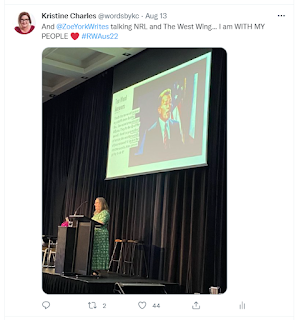
Similarly, Zoe also talked about not just doing what everyone else is doing and thinking that will build your career. She talked about not seeking ten-word answers (i.e. the easy answer) but asking better questions (see the three minute scene from The West Wing here which explains this way better than I can, and you can watch the BRILLIANT Martin Sheen doing the BRILLIANT, albeit pretend, Josiah Bartlet). She also talked about questioning the goals of the person giving you advice and making sure that their goals align with your goals before making the decision to TAKE the advice.


#2 Consequences

Following on from Decisions – we have consequences.

Another message I took away from the conference was to be aware of where I expend my energy.

Becca uses the idea of energy pennies to illustrate this idea: imagine you have a finite number of energy pennies to use for each day, and every decision you make expends a certain number. One penny when you decide what you have for breakfast, twenty to process all the negativity when you start scrolling through Facebook or Twitter, even more when you start fighting with posters, whether online or in your head.

The limited number of energy pennies you have is why you need to make good decisions! You don’t want to be expending energy on decisions that aren’t the right decisions for you, or for your writing career.

#3 Character

And then, decisions and consequences come together in your CHARACTERS!


We were lucky enough to get a two-fer when Maisey Yates and Jackie Ashenden presented their Driven by Character session. Maisey and Jackie are both great - #BFFGOALS – and they talked some about the push/pull of decision and consequence as driving characters along.

They also talked about those decisions and consequences having to be in accordance with the character’s character (i.e. what makes them them), and those decisions and consequences having to have emotional ramifications.

You know, it all sounds so easy when I write it in one little paragraph but… This stuff is hard, and this session was a great reminder.


And, finally, the Award Winners

Last, but not least, CONGRATULATIONS to all of the RUBY award winners for 2022 (list here at the end of Amy Andrews’ latest Booktopia blog), and to the EMERALD (Carrie Clarke) and SAPPHIRE (Tanya Nellestein) award winners.

If you were there, tell us below what were your take aways from Conference? If you weren’t there, do any of my take aways resonate for you?


Kristine Charles writes sexy tales where coffee (and red wine) is abundant, designer shoes and handbags are cheap, chocolate has no calories, and men always put the toilet seat down. Find her at www.wordsbykristinecharles.com or on Facebook, Twitter and Instagram. You can also get her latest - Catch and Kiss - in the It's Always Been You charity anthology (proceeds to breast cancer research) here.


LOVE TO LOVE: the book I’m reading, Ainsley Booth’s PRIME MINISTER, book one in the Frisky Beavers Series (Ainsley is also Zoe York!). This book is fabulous!

LOVE TO LAUGH:

LOVE TO LEARN: From Becca Syme. Her Write Better-Faster courses, and Need to Quit books are the BOMB!

Monday, 5 June 2017

What I Loved About 'RWA 50K in May'

by Marilyn Forsyth

Image courtesy of Giphy
I have just enjoyed the most inspirational month of writing, joining more than 80 other romance writers in the ‘RWA 50K in May’ group. I’d often thought of doing NaNoWriMo, but November is way too busy a time for me. MayNoWriMo, though, I reckoned could do!

Image courtesy of Giphy


Being a pragmatist, I knew I would never reach the dizzying heights of writing 50K over four weeks, so I set 20K as my goal. I'm more than happy to report that in May I more than doubled my usual monthly output.


Participating in the group was, for me, a great exercise in discipline. Every day, even when I was pressed for time or lacking in focus, I had to get some words down because I needed to report my word count each night.


A number of participants came up with some great tips to keep track of progress:

*Anne Gracie suggested rounding down the word count to the nearest hundred, checking how close to the next hundred you are and pushing yourself past it. I used a version of this by rounding down and using anything over that hundred as an automatic head start for the following day.

Link to Kendall's page

*Kendall Talbot posted a chart to achieve 30K in 30 days (above) which was adapted by Suzy Jay. I used a combination of both (below).

My version of the Word Count Chart at the beginning of the month.


*The spreadsheet created by Sarah Brabazon was a great motivator! I had to try to get that red line to meet the green line. (Didn't manage until right at the end, as you can see!)


*Quite a few members joined in sprints, which I wasn’t able to because I leave nights free for family time, but it obviously worked well for them.

At the outset, I did tend to compare my own word count to that of others, but there really is no point to that. With something like this you have to run your own race. I salute writers who can produce several thousand words a day but I have to accept that it’s not what I do.

The thing about joining a group like this is that everyone supports each other, urging one another on to meet our goals. The camaraderie was sensational. As writers, we lead an isolated existence, and it’s great to know that there are others out there experiencing the same things we go through.

Image courtesy of writerswrite.co.za


It was also great to have commiserations when the frustrations of life got in the way, when things didn’t go to plan, or when disaster struck. I had a ‘hot wax’ experience (not as kinky as it possibly sounds😉) where I spilled my ‘ritual’ scented candle over the keyboard, traumatizing my laptop into shutdown mode. It was a very anxious overnight wait to see if I’d lost all the words I’d written, but I was still able to access the group via my ipad, and having people out there who understood the way I was feeling really helped. (The laptop had recovered by the next morning and the words weren’t lost. Yay!)


At the end of the month I had written 20 000 words. Yep, I reached my goal!


Image courtesy of Giphy

And altogether our group wrote over 1 million words!

A huge shout out to Delwyn Jenkins for coordinating the group, and to all my fellow participants. I really enjoyed your company and hope to meet in person those of you going to the conference in BrisVegas, in August.

The idea now is to ‘maintain the rage’, so to speak, and keep that doubled-up weekly word count happening.

Wish me luck!

Have you ever dedicated a month to writing with a group? How did you go?


Love to Love the fact that I’m now close to halfway to finishing my current wip.

Love to Laugh at Juanita Kee’s take on participating in RWA 50K in May. Here’s the link: Procrastination and a Mutinous Muse

Love to Learn different ways to increase my word count!

Monday, 29 May 2017

Miranda's May Musings

How Do You Choose What To Read Next?

Part Two!


Miranda is currently overseas. She hopes to reply to any comments but may not be able to (internet access being difficult at times). Meanwhile, she sends all her lovely regular readers her very best regards, and hopes you enjoy these suggestions for some great Book Review Blogs. 

Darlings, if browsing bookstores or having romance author friends isn't doing it for you with reading recommendations, where next to turn?

Dear reader friends, look at book blogs! I do recognise the irony of writing this on a blog - but hey, it works for me. I get heaps of book blogs handily funnelled into my email. Sometimes, particularly on the first couple of days of the month, I get severe reader envy... You've read all that? In ONE month? You know about all these others? But I am (usually) fairly adult about this reading jealous-ness and move on to peruse the book lists. Which is how I discovered Sally Thorne's The Hating Game after about five billion people recommended it - and having read it, decided it was going to be 'my' pick on The Breathless List which you can see again here:


Picture Credit: www.amazon.com

Which book blogs, you ask? If I wrote them all down you'd be still reading this next week, so let me give you a few examples and you can surf in and check them out. First, I have to give a big shout out to the Australian Romance Readers blog here. You are one click away from romance book paradise. So many authors, so little time! If you are also a writer, look no further than the Romance Writers of Australia blog. A lot of Aussie romance authors also contribute to blogs with colleagues overseas, and the links are on their websites. Let your fingers do the walking.

Romance blogs that feature highly on my read list:

All About Romance. I think I've been reading this since - er, maybe (whispers) the 90's.
RT (Romantic Times) Book Reviews. I also subscribe to their online magazine, and have since (whispers) the 90's. All the hot goss, all the reviews, every month, and the blog more often. I usually want to read everything they top star, so have to whittle it down to a few hundred or so (heh)...
Booktopia's romance blog. Love the Nine Naughty Questions they ask authors, and love the info and new romance releases they feature.
Amazon romance editors get to pick the Best of the Month, and this link also takes you to romance best sellers for the month. Once you get started you'll discover a very pleasant hour - or two or three - has passed.

Picture Credit: Picjumbo

Last but certainly not least, and these are a blast, I *must* mention the entertaining:

Heroes and Heartbreakers, and
Smart Bitches Trashy Books, which I love and adore and giggle over.

Both lead to endless - I repeat, ENDLESS covetous book thoughts from me, plus much amusement at their fun reviews and hilarious comments. It's so easy to get their newsletters and blogs straight into your inbox, or streamed. I highly recommend them both.

Phew! Enough information for now. Now go, get started.

And do share, what reading blogs are in your Top 5?

Love from Miranda xxx


Love to love:     reading romance book blogs. No brainer, really.

Love to laugh:  at some of the snarky comment on the above, especially when I agree.

Love to learn:   about more book blogs. Share your faves with me. Please?


Monday, 21 November 2016

The Last Post: Completing Your Manuscript

with Dee Scully


The Last Post is traditionally a bugle call signalling the end of the day but over the years it has become better known as a farewell to departed servicemen and women. As writers we have no such farewell for our manuscripts. Often it’s difficult to know just when a manuscript is finished; so how do we know when to call it a day, to stop polishing and submit the work and move on to the next manuscript? What is our Last Post?


Breathless’s own Cassandra Samuels, author of A Scandalous Wager, doesn’t feel she’s ever ready to let go. “I know I always feel I can do more…but eventually you have to look at it and say to yourself [that] you have done the best you can with it and now it is time to let some fresh eyes see it. That’s when I send it to my editor."


Multi-published author Nikki Logan says much the same. “I don’t think you’re ever ‘done’ revising. Polishing. Tweaking. Second-guessing. Angsting. After a few books, you come to realise the signs of over-working—not necessarily in the finished product but in your own processes. If I catch myself spending a whole day on a single scene in the final stages of editing I know I’m going too far. That late in the process I should just be flying through the work, buffing a few rough edges. Not reworking.”


Alli Sinclair, author of Under the Spanish Stars and the May 2017 release, Beneath the Parisian Skies, agrees with Cassandra and Nikki. “I’m a perfectionist. In my eyes, a book is never completely finished. There will always be something I want to change, so I’ve had to learn to let go.” 

Alli suggests using the following three-point checklist:

*Have I done structural and copy edits to the best of my ability?
*Have I given it one last read through to make sure it holds together and there are no dangling thread storylines?
*If I read it again, will I vomit? (This is a very big sign that I have read and reread and revised so much that I just can’t stand the sight of it anymore!)


But what is our Reveille, our Last Post, the one thing to tell us our manuscript is ready to submit for publication? All our authors agreed, our Last Post is tweaking. If you’ve structurally edited your story, revised the copy, and made sure there are no plot-holes, then you’re done. If you tweak much more you run the risk of tweaking your voice right out of the manuscript. So, if you’ve done all the above and are just tweaking, stop and heed your writer’s bugle call. The day is done. Your manuscript is finished. Time to submit and move on.

How do you know when your manuscript is ready to submit?

I love to love:  our servicemen and women.  I have them to thank for my freedom.

I love to laugh:  at my iPhone's autocorrect.  Does it really think I don't know how to spell duck?


I love to learn:  new things about writing.  It helps me grow as a writer and as a human being.

Sadly, this will be Dee's last post for Breathless in the Bush. We have loved having her as part of our team and hope to welcome her back at some time in the future. We're sure all her loyal supporters will miss her as much as we will. We wish you well, Dee, and a heart-felt thank you for all you have done for us. xx


Monday, 12 September 2016

REVISION COMPULSION

with Dee Scully

Dee Scully's Revision Checklist
Are you a plotter? An obsessive organiser? Do you struggle to move on from one chapter to the next because you just know there is something that “needs to be tweaked” in the words you wrote yesterday?

I am a plotter and an obsessive organiser who is currently struggling to finish my manuscript because I can’t let the last chapter go. I spend most of my time revising what I wrote yesterday or making copious notes about what needs to be fixed at the earliest convenience (usually at the most inconvenient time), because somewhere in the dark recesses of my subconscious, doubts creep in and niggle at my confidence, eroding any possibility of moving on! A little voice inside my head tells me that my character isn’t being true to herself, or the GMC for my villain is weak and dragging my storyline down, etc…

I know what you’re thinking. “Wow! She’s nuts.” And yeah; you’re right. I am. Being obsessive is keeping me from finishing my manuscript and ultimately keeping me from submitting my work and moving on to the next story percolating in the back of my head.


A half-dozen or so published authors have also told me to move on. (Michael Hauge, James Scott Bell, Cherry Adair—I love and admire you all). I’ve tried to comply. I’ve even tried a 12 step program for alcoholics (even though I’m not an alcoholic) and numerous self-help websites for obsessive compulsives (such as Psych Central). They’ve all been very informative and have helped me outside my writing life.

So far, though, nothing has penetrated the thick carapace of my skull. (I’m so sorry Michael, James, and Cherry. I have listened and I am trying.)

Image courtesy of Dee Scully
I’ve recently decided (as of right now) to embrace my nuttiness. Instead of obsessing over my obsessing, I’m just going to go with it…sort of. I’m still going to write my lists and revise every day. After all, what I’ve been doing—trying to follow the path that everyone else has taken—is not working. While I am decidedly nutty, I am not insane.

From here on out I will write a list at the end of each writing session of what I need to work on. The next day I will spend a portion of time working on it, marking off the list what I’ve achieved. When my allotted revision time is up I will move on to the next chapter.

This may not be the best way to write. It may not be the way the greats do it. But it’s the way I will do it. In the end, how I write doesn’t matter. It’s that I do write and that I eventually get to THE END.


Do you follow 'the rules' of how you should write?  Are you hung-up following the rules, or have you learned to follow the beat of your own drummer?

I love to love…myself. It’s not always easy to love me, but who will if I don’t?

I love to laugh…at all the mistakes I’ve made in the past and how I’ve grown from them.

I love to learn…ways to make me a better person. Self-help books like The Five Love Languages by Gary Chapman have helped me personally and professionally and even improved my writing!

*For anyone needing help with alcoholism or obsessive compulsion, please check out these websites for more information:
Alcoholics Anonymous
Australian Psychological Society 


Check out my weekly Write NOW memes on Instagram.  Created for writers new and old!
Dee Scully
Historical Romance Author
Twitter:  @DeeScullyAuthor


Monday, 5 September 2016

15 Tips for Writing Short Romance


with Marilyn Forsyth


Image courtesy of Giphy
I wish I could remember where I read ‘Get in, get out, make every word count’ because it perfectly encapsulates what a short-story writer must aim for. Stories of 3000 words or less are increasingly popular among romance readers with limited time to indulge their passion.

Image courtesy of Giphy
But if you’re an author interested in writing short stories, be warned: their simplicity might make them appear easy to write but, trust me, they’re not! Prior to deciding to concentrate on single title romances I sold more than a dozen short stories to magazines, but I also had many rejections.The following suggestions are based on my experience.


1. DO keep to 2 main characters, maximum 4. The fewer, the better; there simply isn’t time to develop minor characters. And make sure those 2 main characters are sympathetic and believable.

2. DO draw the reader in quickly. Begin in a moment of conflict or emotional upheaval that will steer your protagonist down a particular path.

3. DO provide all the information needed to grasp the who, what, when and where of your story in the first few paragraphs. Ground your reader by establishing a recognisable setting then make it clear who your protagonist is, what she wants and why she wants it, while at the same time providing questions the reader must find the answers to by reading the story.

Not a good place to start! Image courtesy of Giphy


4. DO have your story take place over a short time span-hours or days work best, years are a no-no.


5. DO make it emotionally honest and heart-warming. Your protagonist should face a situation that almost everyone has experienced and can relate to, like rebuilding life after a breakup or falling in love for the first time.

6. DO trust the intelligence of your reader. By leaving gaps for her (or him) to fill in they’ll get more out of your story.

7. DO use a high proportion of dialogue in your story but only if it moves the story along. Pacing is particularly important in short stories.

8. DO ensure the resolution happens quickly but is also satisfying and believable. Coincidence shouldn’t feature.

9. DO minimise adverbs and adjectives, and make strong verb choices.

10. DO consider your title carefully. Look for key words or phrases within the story to use.


Image courtesy of Pinterest
1. DON’T include lengthy descriptions of setting or characters.

2. DON’T head hop. A of point of view change is okay with 2 characters, but with more than that, head hopping will detract from the reader’s connection with the main characters.

Photo by MF


3. DON’T end with a lifetime commitment. It’s just not believable in a short romance.


4. DON’T attempt a complicated plot. Your story should have all the elements of a novel i.e. character arcs, conflict and resolution, but on a much smaller scale.

5. DON’T include distractions like subplots. Just stick to the central theme of your story.


If you’re looking for a short story contest to enter, RWA’s Little Gems is a great place to start. 2017’s 'theme' gem is Onyx. Why not give it a go?


Photo by MF


Love to Love seeing my crit partner Cassandra Samuels receive her award for winning the Ripping Start Contest from Michael Hauge at the RWA Conference in Adelaide.


Photo by MF


Love to Laugh at some of the ridiculous places I've discovered a red feather from the boa given out at the Harlequin Author party.


Love to Learn more about short-story writing. Check out Kurt Vonnegut 's 8 tips for writing a short story.

Monday, 29 August 2016

How I Survived Post-Manuscript Blues

by Karen M Davis


There is a rumour that writing and depression go together. In fact some documents I have read state it is a fact. Is it any wonder? Writing is an isolated profession. You are alone in a room with a computer and imaginary characters for endless hours, sometimes going without exercise, direct sunlight, enough sleep. Not to mention the ever-present pressure of the deadline looming forebodingly in the back of your mind.

But I'm not talking about depression while writing. That is a whole other subject. I'm talking about post-manuscript depression... When your precious manuscript has left you and is in the hands of others... the publishers. Does anyone else out there worry will it be good enough? Could I have done more? I do. It seems hard to let go of the baby I've been working on for so long, yet at the same time, I know if I had to read through those pages one more time it could be detrimental to myself and anyone around me.

I have just finished my third "Lexie Rogers" novel, Fatal Mistake, and I have to say I found this book harder than the others. Or maybe my memory is fading... Wanting to make it better than the last, I devised a complicated plot that speared off in many different directions to eventually come  back together. Well that was the plan, and after many hours re-plotting, tweaking and slowly going crazy, thankfully that's what happened. Since Fatal Mistake is the third in a series I also had to keep revising my first two books to ensure continuity of characters and storyline. For example, I thought I'd killed off someone's father in the second book but was not sure so I had to read it again and discovered that I didn't. This happened many times - even though I took notes - which was time consuming and draining.

I found that deadline drawing closer with too much left to do so, after a mild panic, I did what I had to do and locked myself in my study, hardly left the house, did no exercise and hardly spoke to anyone other than those who live with me. I  lived on frozen dinners and did minimal housework - everything  I promised myself I would not do - until it was finished. What choice did I have? No one could write the book for me...
Then, to my surprise, when the manuscript was sent off I felt flat. Which was not at all what I had expected. Now what was I going to do? I thought. What was my purpose? I could start another manuscript but I knew I needed a break.

So I made a list...
   
On my list were things I could now do since my work was done. Firstly, I would not feel guilty for having time out. I could relax... spring clean...go for long walks... and catch up with much neglected friends and family. So that's what I'm doing, although it does feel weird. However, ticking off items on a list gives me a sense of accomplishment. I intend to enjoy my down time because before I know it the first edits will be upon me and it will be back to the computer.

What do you like to do, or how do you reward yourself once your hard work is done and the manuscript you are working on is complete?


I love to love... to sit and relax by reading a book.


I love to laugh... at my crazy animals.


I love to learn... about social media because I am sadly lacking.


Monday, 9 May 2016

The Not-So-Dreaded Synopsis and User-friendly Template


with Dee Scully


Question: What beginning writer hasn’t heard, spoken or at least felt these statements before? 
Answer: Not many.

Synopsis writing has become the stuff of urban legends.  Writers only whisper the word, shrinking away from it, pushing it down into the subconscious recesses of their minds where it lies in wait for just the right moment to emerge and wreak havoc with the delicate balance of a daily writing schedule.

But it doesn't have to be that way.


Picture courtesy of Picture Quotes

Yeah, it seems hard. Somehow we have to whittle our 65,000-100,000 word manuscripts down to a meaningful 2-3 pages, encapsulating not only the whole story, including the resolution, but also the voice used when writing it! But what venture worth anything was ever really easy?

I’m not going to profess to be THE BEST SYNOPSIS WRITER OF ALL TIMES. Nor will I say that I’m any good at it, but I will share my template for honing synopses down to the requisite number of pages. My hope is that it will help you to become THE BEST SYNOPSIS WRITER OF ALL TIME.


Dee Scully's Synopsis Template


Don’t get me wrong. This template isn’t going to do the work for you. You still have to get stuck in and do it yourself, but it will give you a base to build on and hopefully at the end you will say, “Synopses aren’t so hard. They lighten my soul. I know my story and can sell it even better now that I’ve written the synopsis!”

Give it a go and let me know your thoughts. If you’ve got any brilliant ideas on how to easily write a synopsis share them in the comments below.

Until later…happy synopsis writing!
D

I love to love…deeply. I don’t ‘fall’ into relationships. I make conscious decisions to always be present to those I love and care for. It’s not easy, but it’s who I am.

Image courtesy of Picture Quotes


I love to laugh…out loud. Those who know me, know this to be true…and usually get caught up and laugh out loud right along with me!

Image courtesy of Pixaby and Dee Scully


I love to learn…new ways to make writing easy and Google always has a ready answer!

Image courtesy of Google