Monday, 17 August 2020

Multiple Time Lines

 by Nicole Hurley-Moore

Hi everyone and it’s lovely to be here again.


I’ve just started writing a couple of new stories and I noticed that I’m beginning to use multiple time lines more often. I really love that you can give so much depth by using different time lines.

In my latest book, The McCalister Legacy the contemporary story of Berry McCalister coming back to her hometown as an adult is the main focus. She hasn’t been back to Harlington since her family was ripped apart by tragedy when she was a child. However, I also used two additional time periods to add more dimensions and maybe even give the reader a hint of what is actually going on.  The first is in 2007 when Berry is a child and the second is from 1906.


I used dual time lines in Lawson’s Bend as well. The main story takes place in 2018 and the second time line is from ten years earlier. In this book the second time line reveals what happened and you are given an insight into the thoughts and the actions of the characters at that time. This helps to add weight to how they react in the present story line.


Personally, I always get a kick out of reading and writing different time lines. I have to admit I love the 1906 story within The McCalister Legacy. It’s about a little kid who follows a rabbit, gets a bit lost and discovers … well, I guess that that bit is a secret.

So what do you think? Do you have a favourite dual time line story? 

I love to watch Korean dramas (no, seriously they’re great and if you’re a hopeless/hopeful romantic like me, you’ll love them too. Thank goodness for Netflix!)

I love to laugh with my family over a good comedy

I love to learn anything new – from a skill, to a recipe to a new language.


Author Bio: A lover of the quiet and peaceful surrounds of the Australian countryside, Nicole Hurley-Moore lives with her family in a rural town in the Victorian Central Highlands and writes full-time. A fan of happily-ever-afters, she writes contemporary rural stories but being a closet medievalist has her occasionally dabbling in the odd medieval tale. Other works by Nicole are McKellar's Run, Hartley's Grange, Country Roads and White Gum Creek.

You can find Nicole on social media at:

Facebook: https://facebook.com/nicole.hurleymoore.author

Twitter: https://twitter.com/nhurleymoore

Pinterest: http://www.pinterest.com/hurleymoore/

Blog: http://nicolehurley-moore.blogspot.com.au

Monday, 10 August 2020

A Wedding Love Affair

by Jayne Kingsley

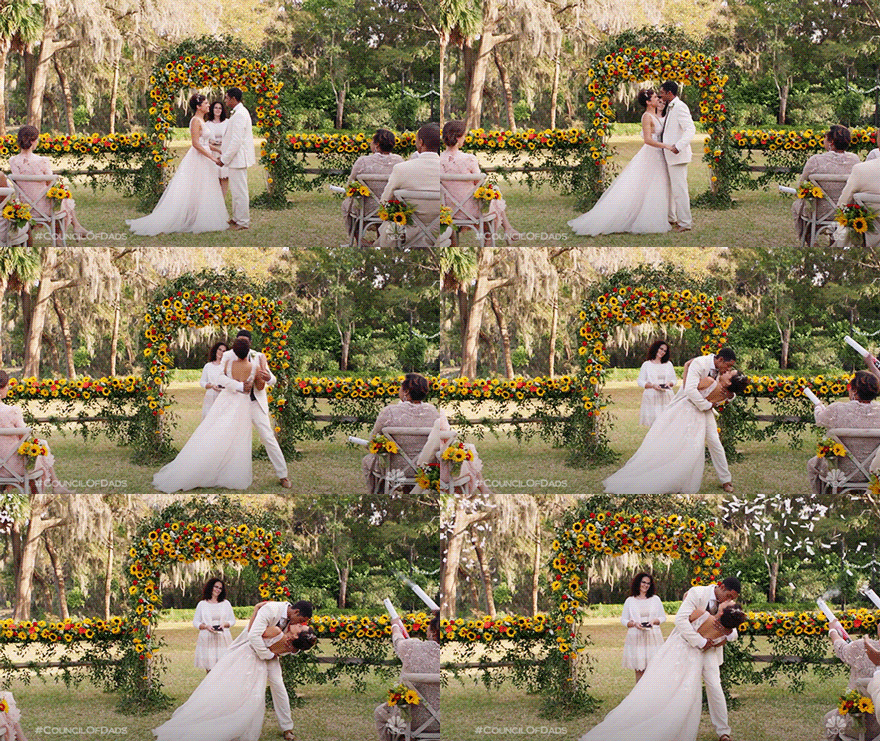
I love weddings. The dress, the music, the ambiance… put a wedding dress on the cover of a book and I’m guaranteed to buy it. There’s just something intrinsically romantic about it to me.

Image Credit: Giphy.com

I’ve recently finished writing a book for an ongoing series called the No Brides Club. I believe my release will be book number 16 in the series, so I guess you could safely say there are others out there that also share my love of wedding-related romance reads. 

(Shameless self-promotion alert! Please feel free to check out the books in the series Here

Image Credit: Amazon


So today—I thought I’d share some of my most favourite wedding related books. Let’s kick off with my all-time favourite: 


Nora Roberts Bride Quartet Series

“Series blurb:

Childhood friends Mackensie, Parker, Laurel and Emmaline have formed a very successful wedding planning business together but, despite helping thousands of happy couples to organise the biggest day of their lives, all four women are unlucky in love.” (Amazon)

I mean, who doesn’t love these books? Four amazing friends, starting a business together—a childhood dream come true. Bonus, they each fall in love with their perfect men. I stumbled across these books when I was planning my wedding so they hold a special place in my heart because of that, but honestly, they are the type of books I can always pick up and get lost in, no matter how often I’ve read them. 

Image Credit: Amazon.com


Catherine Bybee Weekday Brides Series

A premier matchmaking firm where love isn’t part of the deal. Until it is. Catherine Bybee has been a long-time favourite author of mine: part of my list of one clicks. Her books just draw me in. I warn you though; they aren’t a pick up and put down type of book (at least not for me). I always ensure I’ve got a day carved out before I start one, otherwise I know I’ll be cranky if I get pulled away from them. Bonus: there are seven books in the series. 

Image Credit: Amazon.com 


Denise Grover Swank The Wedding Pact Series

“Series blurb:

When Megan, Blair, and Libby were in the fourth grade, they swore they would get married by their thirtieth birthday and include the other two in their weddings. Now, coincidentally, twenty years later, two of the women are engaged and have weddings within months of each other in their hometown of Blue Springs, Missouri. What they all forgot was the fortune teller at a local festival who warned all three their weddings would be a disaster.” (Amazon)

These are fun, delightful, humourous contemporary romances that will have you going back for more. I mean, what’s a wedding without a little drama?

Image Credit: Amazon.com


So these are some of my favourites. I’d love to know yours if you have any?


I love to love... playing barbie weddings with my two daughters.

I love to laugh... at the chatter that occurs during the weddings (there are many people coming down with a virus!)

I love to learn... how bees make honey. Nothing like a rainy weekend to bring out the educational video’s.


Monday, 3 August 2020

Medieval Magpie Pickings (Snippets of Interesting Info)

By Marilyn Forsyth

(This post was inspired by Catherine Meyrick’s blog post ‘Elizabethan Magpie Pickings’. So many interesting snippets about 16th century England!)

I’ve been vicariously inhabiting the world of 12th century Wales for a couple of years now, while I write my Rebel Daughters of Wales timeslip series. Here, for your reading pleasure, are some of my magpie pickings:

1. Women were legally, and with the sanction of the Church, allowed to be beaten by their husbands. The only condition was that the stick used for the beating must be no thicker than the husband’s thumb.

That's a thumbs down from me!

2. For women of the nobility, haute couture was a mark of high status, but such an outward show of pride was not appreciated by Christine de Pisan (medieval writer and historiographer and advocate for women's equality), who wrote: Such women “should especially avoid two things...extravagant head-dress and gowns...and the jostling that goes on when they try to get in front of each other at public functions.” LOL. Seems there have always been those types who need to get noticed.

 
Image courtesy of giphy

3. Speaking of medieval fashion trends... 
Because dresses were so expensive the sleeves were often detachable so that the style could be changed to keep up with the latest style without incurring the cost of a whole new dress. 

4. Despite common belief, medieval people actually did take good care of their teeth. Part of the reason their teeth may not have developed cavities is that sugar was a luxury item and consequently expensive. Many toothpaste recipes that have survived from that time (halitosis, it seems, has never been in vogue). One Welsh recipe says to rub teeth with a mixture of equal parts sage leaves and salt, baked until burnt and powdery.
If toothpaste goes the way toilet paper has gone in the recent crazy times, you’ll now know how to make do. 😉

Image courtesy of giphy

5. Speaking of toilet paper...
It’s probable that anyone who used a garderobe in a castle used either hay or linen scraps to wipe their posteriors. I know which one I’d prefer.

Image courtesy of all-free-download.com

6.
The Battle of Hastings (in which William the Conqueror defeated King Harold II and the Norman dynasty came to power in England) did not take place at Hastings but at the nearby town of (the appropriately named) Battle. (We were to have visited there last month - sob!)

Image courtesy of vintage-news.com

7. Speaking of William the Conqueror...
His death was just as memorable as his life (for all the wrong reasons!). Over the years of his rule, he had grown so obese that his internal organs ruptured when his protruding stomach was thrown against the pommel of his saddle. He passed away some weeks later, his body left naked on the floor while his household servants looted his belongings. Eventually his body was embalmed (despite the festering internal organs) and taken for burial, where it was discovered that his stone sarcophagus was too small to fit him. As his bloated body was being forced into place, his putrefied insides burst. The officiating clergy fled in disgust. Monty Python sketch, or what!

Image courtesy of giphy

8. Princess Nest of Deheubarth was the daughter of King Rhys ap Tewdwr, mistress to Henry I, and wife of Gerald of Pembroke. She was famed not only for her beauty, but also for her involvement in an amazing escapade when her second cousin, Owain, having only just met her, fell instantly in love and abducted her. Little wonder she became known as the Helen of Wales. The question is, did she go willingly? That’s something I explore in my current wip (tentatively titled Nest’s Secret). 

Image of Nest in bed with Henry I 
 
I hope you enjoyed these snippets, garnered from my reading. Do you have a fact that has taken your fancy from your current read?
Using Google Chrome as your browser will enable you to leave a comment. 


Love to Love flowers. My garden is loving the rain.


Love to Laugh at ‘Why Women Kill’. Couldn't get enough of this dark comedy on Foxtel.


Love to Learn about life in medieval times through studying illuminated manuscripts. Thank you, Enisa Haines, for the beautiful book.